

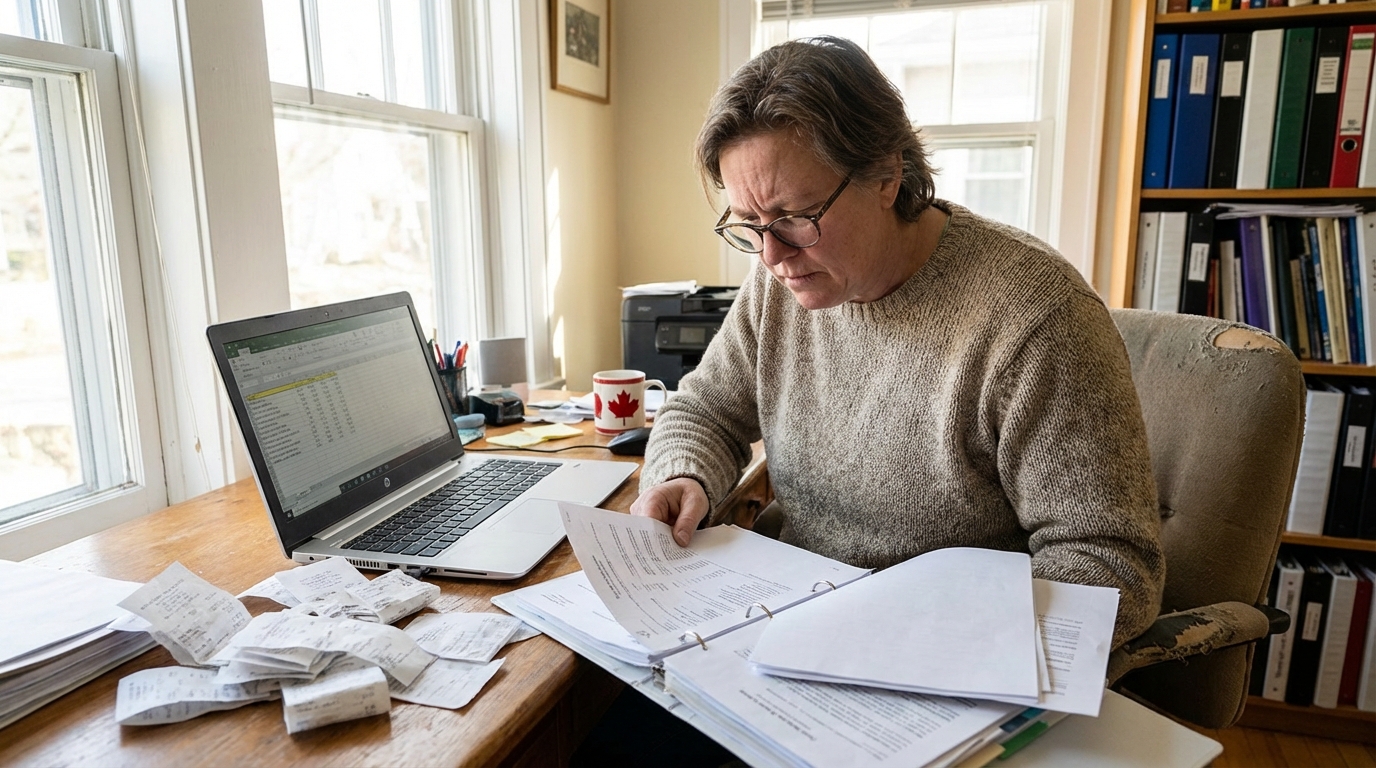
There are over 2.7 million self-employed Canadians, and the majority pay thousands more in taxes than necessary — not because the rates are punishing, but because they don't know which expenses are deductible or how to structure their business. Self-employment brings both opportunity and complexity: you pay both sides of CPP contributions (employee + employer), you must make quarterly tax installments, and you're responsible for tracking every deductible business expense. Do it right and the tax advantages are significant.
The Problem
A freelancer earning $80,000 who doesn't track deductions pays income tax on the full $80,000. The same freelancer with proper expense tracking — home office, equipment, vehicle, professional fees — might reduce taxable income to $55,000–$60,000, saving $8,000–$12,000 in taxes annually.
Business Structure: Sole Proprietor vs. Incorporated
| Feature | Sole Proprietorship | Corporation (CCPC) |
|---|---|---|
| Setup cost | $0–$60 (provincial registration) | $800–$2,500 (legal/filing fees) |
| Corporate tax rate on first $500K profit | N/A — taxed as personal income | 9–12% (Small Business Deduction rate) |
| Personal liability | Full personal liability | Limited liability |
| Tax deferral | No | Yes — leave profits in corp at 9–12%, withdraw later |
| Complexity / cost to maintain | Low | High (annual filing, payroll, corporate returns) |
| Recommended when annual profit exceeds | Always fine up to ~$80K | ~$80,000–$100,000+ |
Incorporation makes financial sense when your net business income consistently exceeds $80,000–$100,000 and you don't need all of it to live on. The difference between the corporate tax rate (9–12%) and your personal marginal rate (40–50%) represents money that can compound inside the corporation tax-deferred. Below $80,000, the accounting costs often outweigh the tax savings.
Deductible Business Expenses: What You Can Claim
| Expense Category | What's Deductible | Notes |
|---|---|---|
| Home office | Proportional share of rent/mortgage interest, utilities, internet | Must use space exclusively and regularly for work |
| Vehicle | Business-use percentage of fuel, insurance, repairs, lease/CCA | Keep a mileage logbook — CRA requires it |
| Equipment & technology | Computers, phones, software, tools used for work | May need to depreciate over years (CCA) |
| Professional development | Courses, conferences, books, subscriptions related to your field | Directly related to your current business |
| Professional fees | Accountant, lawyer, business consultant fees | Fully deductible |
| Marketing & advertising | Website, ads, business cards, promotional materials | Fully deductible |
| Meals & entertainment | 50% of business-related meals with clients | Must have a clear business purpose; document it |
| Health & dental (PHSP) | Private Health Services Plan premiums | Sole proprietors can deduct via a PHSP |
CPP for the Self-Employed: The Double Contribution
This is the biggest surprise for new self-employed Canadians. As an employee, your employer pays half of your CPP contribution. As a self-employed person, you pay both sides — the full 11.9% (2026 rate) on net income between $3,500 and the Year's Maximum Pensionable Earnings (~$68,500). That's approximately $7,731 in CPP contributions on $68,500 of net income.
The upside: half of your CPP contribution (the "employer" portion) is deductible as a business expense, reducing your taxable income. The other half is a non-refundable tax credit.
Quarterly Tax Installments
If your net tax owing exceeds $3,000 in the current or either of the two preceding years, the CRA requires quarterly installments:
- March 15, June 15, September 15, December 15
- Installment amount = prior year's tax owing ÷ 4 (or CRA's calculated amount)
- Missing installments triggers interest charges at the CRA prescribed rate (currently 8–10%)
Most self-employed people should set aside 25–30% of every payment received into a separate "tax savings" account, then pay installments from that account quarterly. This eliminates the end-of-year tax bill surprise.
Start Here: Four Actions
1) Open a separate business bank account — never mix personal and business. 2) Use accounting software (Wave is free; QuickBooks is ~$20/mo) to track every expense from day one. 3) Set aside 28–32% of each invoice payment for taxes and CPP. 4) Consult a CPA specializing in self-employment for your first tax year — the fee ($400–$900) typically pays for itself in discovered deductions many times over.
HST/GST Registration
You must register for GST/HST when your cumulative revenue in any 12-month period exceeds $30,000. Once registered, you collect HST on invoices and remit the net (HST collected minus HST paid on business purchases — the "input tax credit"). Many self-employed people in their first year forget to register at the right time; late registration triggers back-payment of all HST that should have been collected from the $30,000 threshold date. If you're approaching $30,000, register proactively.